lunedì 20 dicembre 2010

Great Luxury in Rome

Via Veneto is one of the most famous and expensive streets in Rome. The official name is via Vittorio Veneto. Federico Fellini's classic 1960 film La Dolce Vita was mostly centered around the Via Veneto area. This made the street famous in the 1960s–1970s and turned it into a center for upmarket cafes and shops.
Fellini and friends made this urbane avenue, with its abundance of tony outdoor cafés, famous. Today it is home to some of Rome's fanciest hotels. As you proceed down the Veneto, you will pass the imposing American Embassy on your left. Following a period of stagnation in the 1980s the street has now found a new life. Today some of Rome's best hotels are located there.
Via Veneto is home to the most expensive cafés, restaurants, hotels of Rome. Just near via veneto you will find TEATRO SISTINA which is one of the most famous theatres in rome : shows, concerts, theatrical performances are played here.


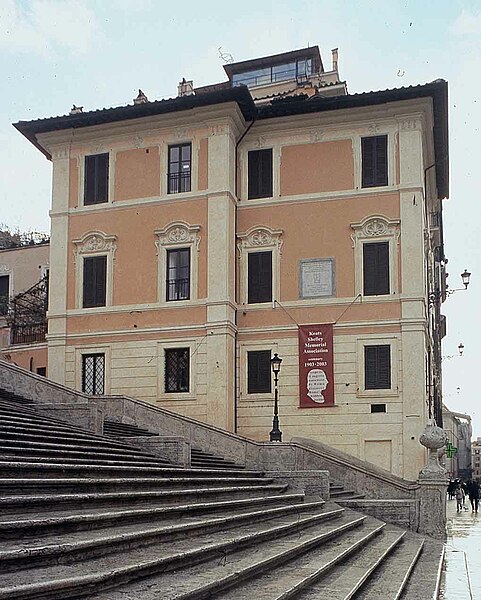
What a Romantic museum..!!!


The Keats-Shelley Memorial House in Rome is a museum commemorating the lives and works of the Romantic poets John Keats and Percy Bysshe Shelley. The museum houses one of the world's most extensive collections of memorabilia, letters, manuscripts, and paintings relating to Keats and Shelley, as well as Byron, Wordsworth, Robert Browning, Elizabeth Barrett Browning, Oscar Wilde, and others. It is located on the second floor of the building situated just to the south of the base of the Spanish Steps and east of the Piazza di Spagna. Keats Shelley Museum (Piazza di Spagna 26; www.keats-shelley-house.org) is an homage to the two Romantic poets, who spent their final years in Italy. In fact, the museum is housed in the building in which John Keats died in 1821.
The English poet John Keats, who was dying of tuberculosis, came to Rome at the urging of friends and doctors who hoped that the warmer climate might improve his health. The building at Piazza di Spagna 26 was remodelled as part of the project to build the Spanish Steps in 1724-25. The project was designed by Francesco de Sanctis, who wanted to frame the steps with an identical building on either side.

This is the Keats-Shelley Memorial Association: for further information visit the website


The Mouth of Truth

The Mouth of Truth is well known to English-speaking audiences mostly from its appearance in the film Roman Holiday. The film also uses the Mouth of Truth as a storytelling device since both Hepburn's and Peck's characters are not initially truthful with each other.
La Bocca della Verità ("the Mouth of Truth") is an image, carved from Pavonazzetto marble, of a man-like face, located in the portico of the church of Santa Maria in Cosmedin in Rome. The sculpture is thought to be part of a 1st century ancient Roman fountain, or perhaps a manhole cover, portraying one of several possible pagan gods, probably Oceanus. Most Romans believe that the 'Bocca' represents the ancient god of the river Tiber.
The most famous characteristic of the Mouth, however, is its role as a lie detector. Starting from the Middle Ages, it was believed that if one told a lie with one's hand in the mouth of the sculpture, it would be bitten off. The piece was placed in the portico of the Santa Maria in Cosmedin in the 17th century.


venerdì 17 dicembre 2010

Professional Congress Hostess

The main duty of a Professional Congress Hostess is to set up and implement a congress or  a social event from the very start to the end of it.  She  takes care of fulfilling customers' needs  who partecipate to cultural, sport, religious events,  conventions, workshops, seminars,conferences, congresses, exhibitions.
She is asked to set  up and check the  list and number of partecipants,  welcome them at the entrance of the exhibition or congress, check down their personal information,  distribute brochures, dépliants and leaflets, accompany them in the rooms where the congress is going to take place, invite them to have lunch or dinner, give them any information about the congress schedule, about monuments, shopping, bank closing hours,transport & tourist information, give them language assistance for the whole  duration of the congress, let them know about social events taking place in the town that hosts the congress. 
 She is asked to fulfill customers' needs,  being a valid support to her boss,  informing him/her  of changes that may occur during the congress. She must speak at least 2 foreign languages, have a well round education, be sensitive, reliable, having elegant manners.  Great hotels, palaces, villas, embassies are the locations chosen  for these events.  She is also assumed  to have a very good knowledge of computer science and its main software applications.  
She is needed to have a higher diploma  in foreign languages or tourism; besides this she is asked to be good looking, having very good manners, being kind, reliable, punctual, efficient, taking responsibilities. She's also assumed  to be healthy, very calm and patient....it's not a job to be underestimated...! Only if you think to have all of these characetristics, please take your own risk and try.

Language Assistance & Welcoming Desk Operator

I have been collaborating with services agencies to set up and implement congresses and meetings,  of any size in ROME such as educational seminars, professional or educational tours, training courses, meetings, summits, stand alone events.
Working as a public relations operator means beeing  concentrated on ensuring clients' business success, working together to achieve their strategic objectives. It is important to establish  long-standing relations with many of them. Here you have a series of what is called the overall HOSPITALITY SERVICE for a congress:
  • room block reservations and contracts with hotels
  • handling of individual and group accommodation applications (on-line, by fax or by email)
  • organisation of ground transportation services (private transfers, shuttle services etc)
  • air-tickets reservations
  • organisation of tours, dinners and social events
  • organisation of tailor made events
  • on-site support through hospitality desks
  • meet & assist services at the airport

The Church Of The Artists

Santa Maria dei Miracoli and Santa Maria di Montesanto are two churches in Rome.
They are located on the Piazza del Popolo  at the entrance of Via del Corso on the square. The churches are often cited as "twin", due to their similar external appearance: they have indeed some differences, in both plan and exterior details.
The "twin" churches of Santa Maria di Montesanto (left) and Santa Maria dei Miracoli (right), seen from Piazza del Popolo. Between the two churches Via del Corso starts. Although very similar, differences can been seen in this image in the two small belfrys and in the two domes.
Santa Maria in Montesanto is well known  as  The Church of the Artists : when famous movie  or stage actors/actresses, artists die,  the funeral mass is usually celebrated in this church: that 's why it is called THE CHURCH OF THE ARTISTS.


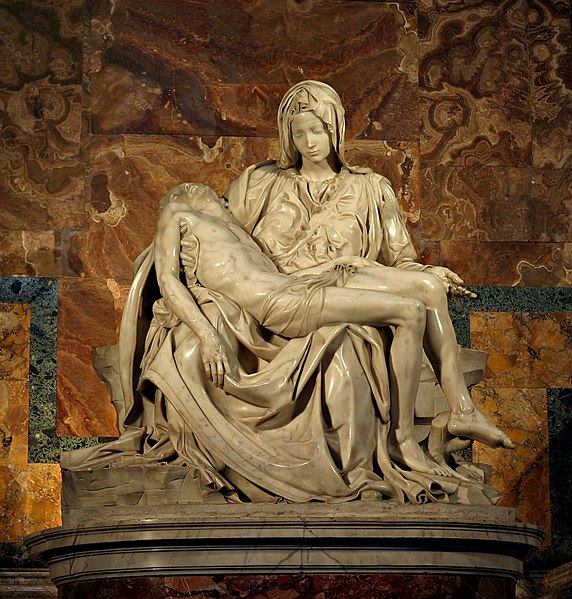
MIchelangelo's masterpiece..!

The Pietà is a masterpiece of Renaissance sculpture by the renowned artist Michelangelo Buonarroti, housed in St. Peter's Basilica. It is the first of a number of works of the same theme by the artist. The statue was commissioned for the French cardinal Jean de Billheres, who was a representative in Rome. The statue was made for the cardinal's funeral monument, but was moved to its current location, the first chapel on the right as one enters the basilica, in the 18th century. It is the only piece Michelangelo ever signed (See History after completion).
This famous work of art depicts the body of Jesus on the lap of his mother Mary after the Crucifixion. The theme is of Northern origin, popular by that time in France but not yet in Italy. Michelangelo's interpretation of the Pietà is unique to the precedents. It is an important work as it balances the Renaissance ideals of classical beauty with naturalism. The statue is one of the most highly finished works by Michelangelo.


Some Important Places in rome

Renaissance and Baroque

Rome was a major world centre of the Renaissance, second only to Florence, and was profoundly affected by the movement. Among others, a masterpiece of Renaissance architecture in Rome is the Piazza del Campidoglio by Michelangelo. During this period, the great aristocratic families of Rome used to build opulent dwellings as the Palazzo del Quirinale (now seat of the President of the Italian Republic), the Palazzo Venezia, the Palazzo Farnese, the Palazzo Barberini, the Palazzo Chigi (now seat of the Italian Prime Minister), the Palazzo Spada, the Palazzo della Cancelleria, and the Villa Farnesina.
Many of the famous city's squares - some huge, majestic and often adorned with obelisks, some small and pictoresque - got their present shape during the Renaissance and Baroque. The principal ones are Piazza Navona, Piazza di Spagna, Campo de' Fiori, Piazza Venezia, Piazza Farnese, Piazza della Rotonda and Piazza della Minerva. One of the most emblematic examples of Baroque art is the Fontana di Trevi by Nicola Salvi. Other notable 17th-century baroque palaces are the Palazzo Madama, now the seat of the Italian Senate and the Palazzo Montecitorio, now the seat of the Chamber of Deputies of Italy.

giovedì 16 dicembre 2010

Myths never die !

Callas's voice was and remains controversial; it bothered and disturbed as many as it thrilled and inspired. Walter Legge stated that Callas possessed that most essential ingredient for a great singer: an instantly recognizable voice.During "The Callas Debate", Italian critic Rodolfo Celletti stated, "The timbre of Callas's voice, considered purely as sound, was essentially ugly: it was a thin sound, which gave the impression of dryness, of aridity.
Callas's voice has been difficult to place in the modern vocal classification or fach system, especially since in her prime, her repertoire contained the heaviest dramatic soprano roles as well as roles usually undertaken by the highest, lightest and most agile coloratura sopranos. Regarding this versatility, Maestro Tullio Serafin said, "This woman can sing anything written for the female voice".
Though adored by many opera enthusiasts, Callas was a controversial artist. While Callas was the great singer often dismissed simply as an actress. She considered herself first and foremost "a musician, that is, the first instrument of the orchestra.


An ENCHANTING place...!

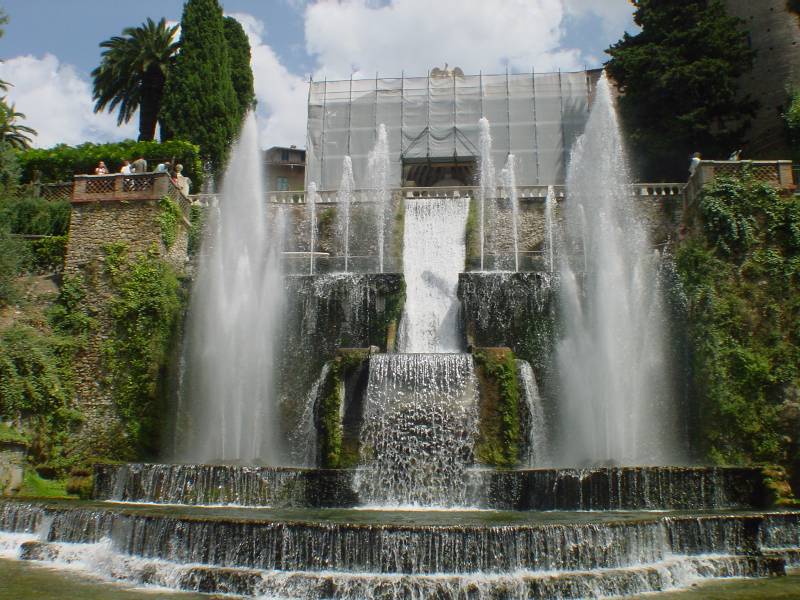
VILLA D'ESTE
Tivoli  is an ancient Italian town in Lazio, about 30 km from Rome. There are spectacular views out over the Roman Campagna. Tivoli's reputation as a stylish resort and the fame of the gardens of the Villa d'Este have inspired other sites named Tivoli.
Tivoli has a Mediterranean climate with warm and dry summers and cool and wet winters.The main sights of TIVOLI are:
 The Villa d'Este is a villa situated near Rome. Listed as a UNESCO world heritage site, it is a fine example of Renaissance architecture and the Italian Renaissance garden.
The garden plan is laid out on a central axis with subsidiary cross-axes of carefully varied character, refreshed by some five hundred jets in fountains, pools and water troughs. The copious water is supplied by the Aniene, which is partly diverted through the town, a distance of a kilometer, and by the Rivellese spring, which supplies a cistern under the villa's courtyard. The garden is now part of the Grandi Giardini Italiani.
The Villa's uppermost terrace ends in a balustraded balcony at the left end, with a sweeping view over the plain below. Symmetrical double flights of stairs flanking the central axis lead to the next garden terrace, with the Grotto of Diana, richly decorated with frescoes and pebble mosaic to one side and the central Fontana del Bicchierone ("Fountain of the Great Cup") loosely attributed to Bernini, where water issues from a seemingly natural rock into a scrolling shell-like cup.

Thermal Baths of Stigliano..

TERME DI STIGLIANO Srl
Via Bagni di Stigliano,
00060 Canale Monterano (RM)
Tel. +39 06 99805977 Fax +39 06 9963428
www.termedistigliano.it
info@termedistigliano.it

.....The Thermal Baths of STIGLIANO are situated just 50 km from rome......every season of the year they take care of you .....

The Thermal Waters of Saturnia

The Terme di Saturnia are a group of springs located in the municipality of Manciano, a few kilometers from the village of Saturnia.
One legend, according to the Etruscans and Romans, was that the Terme di Saturnia were formed by lightning bolts, thrown by Jupiter. During a violent quarrel between the two mythological deities, the bolts thrown towards Saturn had missed, causing the formations.

The sulphurous spring water, at a temperature of 37.5 °C, are well-known for their therapeutic properties, offering relaxation and well being through immersion. The main thermal waterfalls are the Mill Falls, located at an old mill as well as the Waterfalls of Gorello.
The yield of the source is about 800 liters per second, which guarantees an optimal replacement of water. The chemical make-up is sulfur, carbon, sulfate, bicarbonate-alkaline, earth, with the presence of hydrogen sulfide gas and carbon dioxide. The minerals dissolved in water amount to 2.79 grams per liter.
The area of Saturnia Spa presents, as a whole, a large and freely accessible area where it has developed the famed luxury spa of Terme di Saturnia, where, in addition to various thermal treatments, also produces thermal perfumes and creams for men and women.

The Lake of Bracciano...just outside Rome..!

Bracciano  is a small town in the region of Lazio, 30 km northwest of Rome. The town is famous for its volcanic lake (Lago di Bracciano, the eighth largest lake in Italy) and for a particularly well-preserved medieval castle. The lake is widely used for sailing and is popular with tourists; the castle has hosted a number of events, especially weddings of actors and singers.
The town is served by an urban railway which connects it with Rome  in about 55 minutes. Close to it lie the two medieval towns of Anguillara Sabazia and Trevignano Romano.
The main monument of Bracciano is its castle, Castello Orsini-Odescalchi, one of the most noteworthy examples of Renaissance military architecture in Italy.

3 km outside the city, alongside the road leading to Trevignano Romano, is the ancient church of San Liberato.
The lake is an important tourist attraction situated near Rome. As it serves as a drinking water reservoir for the city of Rome it has been under control since 1986 in order to avoid pollution of its waters. The use of motorboats is strictly forbidden, and a centralised sewer system has been built for all the bordering towns in order to avoid any spoiling of the water quality. This makes Bracciano one of the cleanest lakes of Italy. The absence of motorized navigation favours sailing, canoeing and swimming.
In the last few years the lake and its surroundings have been brought under further protection by the creation of a regional park, the Parco Regionale del complesso lacuale di Bracciano Martignano.


the most talented of Roman actresses..!

Anna Magnani was an Italian stage and film actress. She won the Academy Award for Best Actress, along with four other international awards, for her portrayal of a Sicilian widow in The Rose Tattoo. Born in Rome to an Egyptian father and an Italian-Jewish mother, she worked her way through Rome's Academy of Dramatic Art by singing at night clubs. During her career, her only child was stricken by Polio when he was 18 months old and remained crippled.
She was referred to as "La Lupa," the "perennial toast of Rome" and a "living she-wolf symbol" of the cinema. Time magazine described her personality as "fiery," and drama critic Harold Clurman said her acting was "volcanic." In the realm of Italian cinema, she was "passionate, fearless, and exciting," an actress that film historian Barry Monush calls "the volcanic earth mother of all Italian cinema." Director Roberto Rossellini called her "the greatest acting genius" since Eleonora Duse. Playwright Tennessee Williams became an admirer of her acting and wrote The Rose Tattoo specifically for her to star in, a role for which she received her first Oscar in 1955.


La Dolce Vita


La Dolce Vita is a 1960 film by the critically acclaimed director Federico Fellini. The film is a story of a passive journalist's week in Rome, and his search for both happiness and love that will never come. Generally cited as the film that marks the transition between Fellini's earlier neo-realist films and his later art films, it is widely considered one of the great achievements in world cinema. In various interviews, Fellini claimed that the film's initial inspiration was in fact this particular style.
Brunello Rondi, Fellini's co-screenwriter and long-time collaborator, confirmed this view explaining that "the fashion of women's sack dresses which possessed that sense of luxurious butterflying out around a body that might be physically beautiful but not morally so; these sack dresses struck Fellini because they rendered a woman very gorgeous who could, instead, be a skeleton of squalor and solitude inside."The famous scene in the Trevi Fountain  was shot over a week in winter. Fellini claimed that Ekberg stood in the cold water in her dress for hours without any trouble while Mastroianni had to wear a wetsuit beneath his clothes - to no avail. It was only after "he polished off a bottle of vodka" that Fellini could shoot the scene with a drunk Mastroianni.

mercoledì 15 dicembre 2010

Rome Film Festival

Rome Film Festival is a film festival that takes place in Rome during the month of October. The last edition was held from October 15 to 23, 2009. The actual complete name in Italian is Festival Internazionale del Film di Roma.
Even though it is quite a young festival at its second edition, the importance of the hosting city as well as the strong economic investment has placed the Rome Film Feast among the most important film festivals in the world, with huge media coverage and world-famous artists on attendance.
Besides, along with the festival, a film market called the Business Street is set up in the Via Veneto, well-known due to 1960s La dolce vita.
The Rome Film Festival award is a silver statuette shaped after the Roman Emperor Marcus Aurelius statue, placed in Michelangelo's Campidoglio Square, arguably one of the most recognizable symbols of Rome. Created by the Rome-based jewelry maker Bulgari, the prize will be assigned to the Best Film, the Best Actor and the Best Actress.
The Rome Film Fest’s Jury is composed by a president, normally a renowned director (2006 edition, Ettore Scola), and 50 Jurors, which, unlike most film festivals, are not film professionals. In fact, it is a People's Jury made up by common moviegoers selected both in Italy and Europe.

Italian Modern Cinema....

The history of Italian cinema began just a few months after the Lumière brothers had discovered the medium, when Pope Leo XIII was filmed for a few seconds in the act of blessing the camera.
A new generation of directors has helped return Italian cinema to a healthy level since the end of the 1980s. The sign-bearer for this renaissance is Nuovo Cinema Paradiso, for which Giuseppe Tornatore won the Oscar for Best Foreign Film in 1990. This victory was followed two years later by another, when Gabriele Salvatores's Mediterraneo won the same prize. Another exploit was in 1998 when Roberto Benigni won three oscars for his movie Life Is Beautiful (La vita è bella) (Best Actor, Best Foreign Film, Best Music). 
Other recent films of note include: Jona che visse nella balena directed by Roberto Faenza, Il grande cocomero by Francesca Archibugi, Il mestiere delle armi by Olmi, L'ora di religione by Marco Bellocchio, Il ladro di bambini, Lamerica, Le chiavi di casa by Gianni Amelio, Io non ho paura by Gabriele Salvatores, Le fate ignoranti, La finestra di fronte by Ferzan Özpetek, La bestia nel cuore by Cristina Comencini.
In 2007 American director Quentin Tarantino said "New Italian cinema is just depressing. Recent films I've seen are all the same. They talk about boys growing up, or girls growing up, or couples having a crisis, or vacations of the mentally impaired." He received criticism from the Italian media and actress Sophia Loren who said "How dare he talk about Italian cinema when he doesn't know anything about American cinema?"


Cinecittà: the cradle of Italian Cinema

Cinecittà is a large film studio in Rome that is considered the hub of Italian cinema.
As the home of Italian cinema, Cinecittà has seen the production of many classic films such as La dolce vita and Satyricon.
Since the days of Ben Hur, the studios have welcomed international productions, recent examples include Martin Scorsese's Gangs of New York and Wes Anderson's The Life Aquatic with Steve Zissou.
Cinecittà also hosts TV productions, such as Grande Fratello, the Italian version of Big Brother, where the Big Brother house is built on Cinecittà's premises. It has also been home to the filming of the Passion of the Christ, starring James Caviezel and directed by Mel Gibson.
Additionally, the BBC/HBO series Rome was filmed there from 2004-2007, the show being widely acclaimed for its sets and designs.

nice places to spend the night....

MEO PINELLI

Situated near the glossy world of Cinecittà, the large film studio in Rome, Meo Pinelli specializes in taking good care of an international clientele from morning to night.
For breakfast, fill up on pastries and homemade sweet treats or go for the healthier choice: cereals, fresh yoghurt and fruit. At lunchtime things step up a gear and guests can choose between a buffet or the à la carte menu. The buffet is laden with the best of Italian cuisine made with prime ingredients. Afternoon teatime is a delight, especially during the colder months: warm up with sweet treats prepared by the chef and a cup of delicious hot chocolate. The ever-famous Italian aperitif time follows and brings with it a rich buffet, the best of Italian wines and a good selection of cocktails and blended drinks. After whetting your appetite with tasty appetizers why not stay for dinner; the menu offers meat, seafood dishes and excellent wood-oven baked pizzas. The staff often organize after-dinner themed events.
Open daily from 6am-2am.

martedì 14 dicembre 2010

The Military Order of the Knights of Malta

At the top of Aventine Hill in Via di Santa Sabina stands the Santa Sabina Monastery. Inside the church you will find beautifully decorated marble friezes, flooring, and a well lit nave, but outside in Parco Savello you can admire the second best views of Rome (after Janiculum hill) over and across the Tiber River towards St Peters. The Parco Savello is also known as the  Garden of Oranges (Giardino degli Aranci), is located on the Aventine Hill and faces onto the Tiber River, affording a breathtaking view over the city of Rome as well as the Pincio and the Janiculum hill. As you exit the monastery turn right and only a couple of steps away at the end of Santa Sabina you will find the square: "Piazza dei Cavalieri di Malta", on the right hand side of the square you will find the large white sculpted entrance facade of the Military Order of The Knights of Malta.
In these gates you will find a brass keyhole where you can look through three lands (Malta, Italy and The Vatican) and see the Cupola of St Peters.

PERSONAL INFORMATION

Please leave a message or a comment .....your own impressions and suggestions about this web site....I will be delighted to read you. I work as translator and congress operator as well as Language Assistant for foreigners coming visit the Eternal City .
Feel free to add any comment or ask me information about my job.

MARIA ANGELA

PERSONAL INFORMATION

Translation Services from/into English, French, Italian,Welcoming Service,Congress Operator, Language Assistance into English, French, Italian.

MARIA ANGELA