Visualizzazione post con etichetta Beauties of Rome. Mostra tutti i post

mercoledì 16 febbraio 2011

A Folkloristic Exhibition just outside Rome


In June, a great folkloristic and religious exhibition, the "Infiorata". A whole street (Via Italo Belardi) is covered with allegorical carpets of flowers and a masked parade walk on these, with medieval and traditional clothes realized by town's women. For more than 2 centuries  on Sunday and Monday following Corpus Christus feast the Infiorata a most suggestive manifestation of art, pride of the artists of Genzano has taken place . Each year the artists suggestions must conform to a previously agreed upon theme, such as The Colours of Michelangelo, or The Designs of Bernini. In the spring it has recently become tradition to have a "mini Infiorata" made by the children from the local schools.
Poets and writers wrote about the Infiorata:
  • Massimo d'Azeglio "...you see the fair, the people, the truly rare beauty of the town crowds of Roman, holiday makers from the nearby Castles....everything lively; and seen from the foot of the ascent it seems to be a magnificent carpet, that you regret to see spoilt by the feet of the procession".
  • Richard Voss "One of the most beautiful Italian fairs is held in Genzano, the fair of flowers; the whole city seems to be a gigantic flower bed. A marvellous spectacle".
  • Hans Christian Andersen "The whole street is a carpet of flowers.... Not even a breathe of air moves and the flowers lie on the ground as if they were heavy precious stones...".

Unforgettable Garden of Oranges in Rome

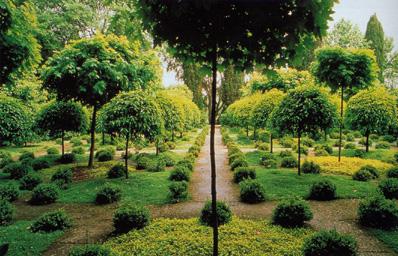
The Savello park, also known as the Garden of Oranges (Giardino degli Aranci), is located on the Aventine Hill and faces onto the Tiber River, affording a breathtaking view over the city of Rome as well as the Pincio and the Janiculum hill. This gorgeous park is often choosen to take pictures after having celebrated the wedding ceremony at the Basilica of Santa SABINA.
The park, a hanging garden with a surface of about 8000 sqm which can be seen from the Piazza di Monte Savello, is famous for its many bitter orange trees. The tranquil Garden of Oranges  affords fantastic views of the many monuments, roof tops and domes of Rome, encapsulating flavors of the modern and medieval on its shady walkways. The park itself fits neatly behind the ancient Basilica of Santa Sabina. Though they produce bitter fruit, they give a pleasant shady air to the garden, affording a lovely retreat from the bustle and noise of urban life. During the summer it is no surprise that the garden is the choice setting for theatrical productions, a favorite resting spot for visitors touring Rome and the haunt of lovers. Perhaps the inspiring view and romantic ambience offers the ideal prompt for falling at the feet of one's beloved!

Don't Miss this Cultural Centre

The Palazzo delle Esposizioni is a neoclassical exhibition hall, cultural centre and museum on Via Nazionale.
It has housed several exhibitions (e.g. Mostra della Rivoluzione Fascista, Mostra Augustea della Romanità, Gli acquerelli di Marc Chagall), and was temporarily modified during the fascist era due to its style being thought to be out of step with the times.
It has a 139 seat cinema, a 90-seat auditorium, a cafe, a 240-person restaurant, a library and a multi-functional room known as the Forum.
It's an amazing, outstanding PALAZZO right in the centre of rome: the most important and innovative exhibitions are held here.

http://english.palazzoesposizioni.it/mediacenter/FE/home.aspx


Remembering a Great English Poet !


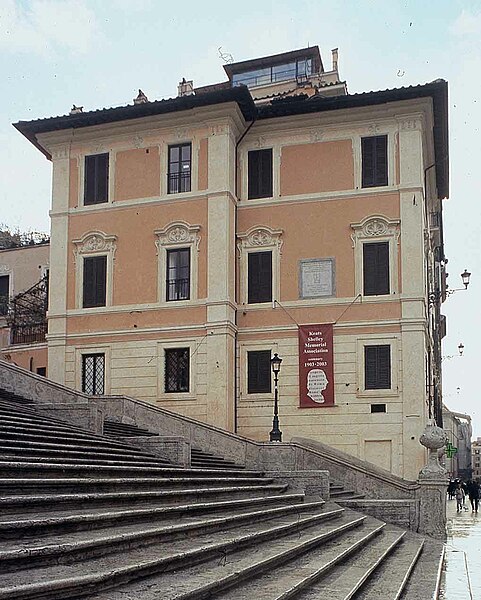
The Keats-Shelley Memorial House in Rome is a museum commemorating the lives and works of the Romantic poets John Keats and Percy Bysshe Shelley. The museum houses one of the world's most extensive collections of memorabilia, letters, manuscripts, and paintings relating to Keats and Shelley, as well as Byron, Wordsworth, Robert Browning, Elizabeth Barrett Browning, Oscar Wilde, and others. It is located on the second floor of the building situated just to the south of the base of the Spanish Steps and east of the Piazza di Spagna. Keats Shelley Museum (Piazza di Spagna 26; www.keats-shelley-house.org) is an homage to the two Romantic poets, who spent their final years in Italy. In fact, the museum is housed in the building in which John Keats died in 1821.
The English poet John Keats, who was dying of tuberculosis, came to Rome at the urging of friends and doctors who hoped that the warmer climate might improve his health. The building at Piazza di Spagna 26 was remodelled as part of the project to build the Spanish Steps in 1724-25. The project was designed by Francesco de Sanctis, who wanted to frame the steps with an identical building on either side.

This is the Keats-Shelley Memorial Association: for further information visit the website

Visiting Villa Medici


The Villa Medici is an architectural complex centred on the villa whose gardens are contiguous with the larger Borghese gardens, on the Pincian Hill next to Trinità dei Monti in Rome. The Villa Medici, founded by Ferdinando I de' Medici, Grand Duke of Tuscany and now property of the French State, has housed the French Academy in Rome since 1803. A musical evocation of its garden fountains features in Ottorino Respighi's Fontane di Roma.
In 1803, Napoleon Bonaparte moved the French Academy in Rome to the Villa Medici with the intention of preserving an institution once threatened by the French Revolution. 
From that time on, the boarders no longer belonged solely to the traditional disciplines (painting, sculpture, architecture, metal-engraving, precious-stone engraving, musical composition, etc.) but also to new or previously-neglected artistic fields (art history, archaeology, literature, stagecraft, photography, movies, video, art restoration, writing and even cookery.) Artists are no longer recruited by a competition but by application, and their stays generally vary from six to eighteen months.

venerdì 4 febbraio 2011

Palazzo Braschi


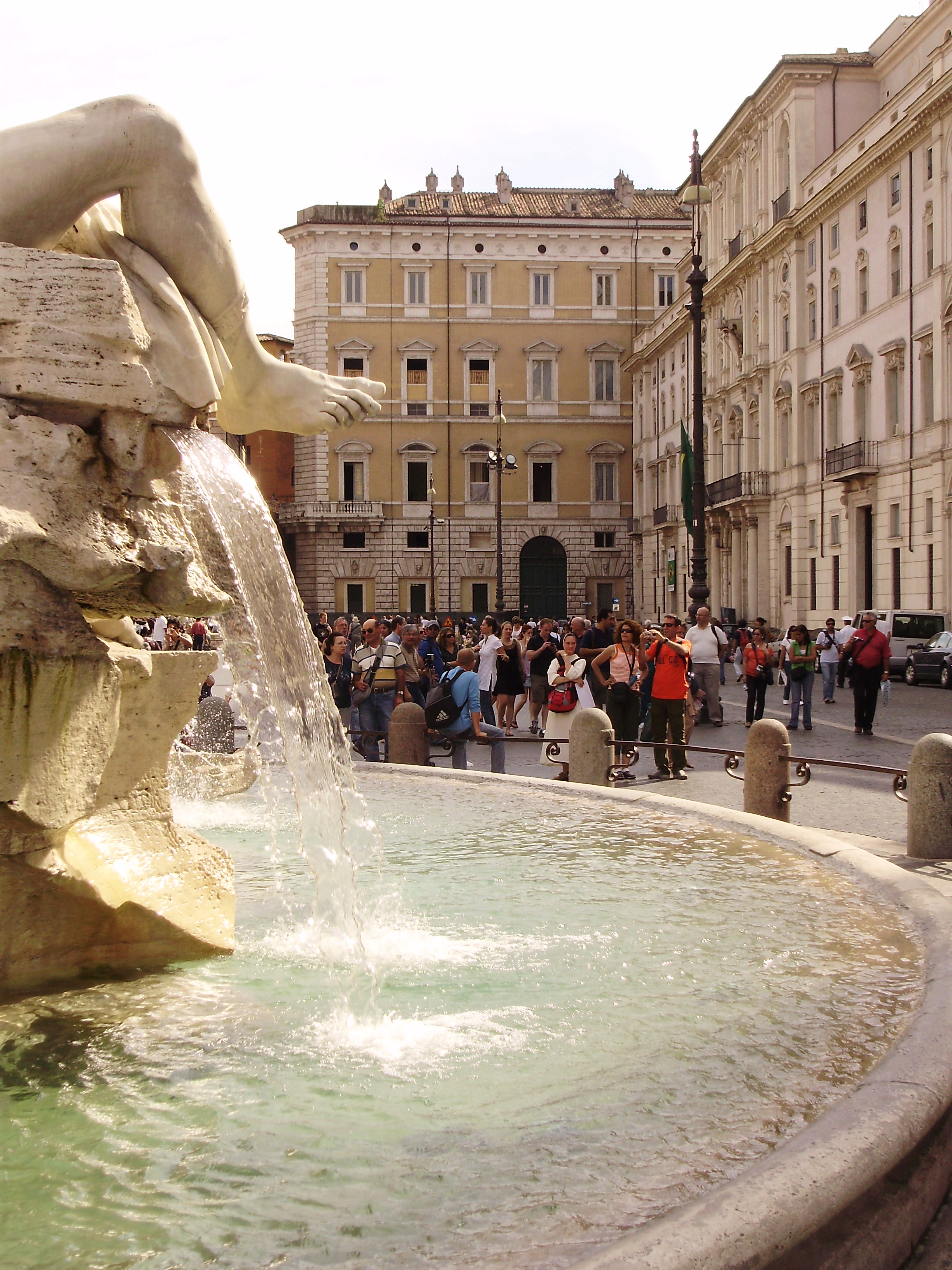
Palazzo Braschi is a large Neoclassical palace in Rome,  and is located between the Piazza Navona, the Campo de' Fiori, the Corso Vittorio Emanuele II and the Piazza di Pasquino. It presently houses the Museo di Roma, the civic museum of Rome.It was built by the papal nephew Duke Luigi Braschi Onesti, to designs by Cosimo Morelli. 
The main entrance is on Via San Pantaleo (between Piazza Navona and Corso Vittorio Emanuele). The oval hall inside the main entrance overlooks Via San Pantaleo, and leads to the monumental staircase with its eighteen red granite columns which came from the gallery built by the Emperor Caligula on the banks of the River Tiber. Decorating the staircase there are ancient sculptures and fine stuccoes by Luigi Acquisti inspired by the myth of Achilles.
The architect Giuseppe Valadier designed the chapel on the piano nobile or first floor.
Palazzo Braschi is a lavish palazzo overlooking Piazza Navona, which is now home to the Museum of Rome.
Palazzo Braschi staircase The Museo di Roma has a vast collection dedicated to the history of the city from the Middle Ages to the early twentieth century. Only part of this assortment of drawings, paintings, sculptures, frescoes, costumes etc. is on display at any one time. There is an eclectic feel to the display, which is rather like a book whose text is missing, leaving only the illustrations.
From busts of popes to paintings of peasants, the different human experiences of Rome are illustrated through the stately rooms of Palazzo Braschi. One of the oddest exhibits is a sequence of portraits (1667-1669) of a young scion of the Rospigliosi family (Pietro Banchieri), obviously the apple of his aristocratic family's eye, dressed up in a range of costumes: a dancer, Cupid, a Swiss Guard and even a lady. There is more than a trace of a fed-up expression on the poor boy's face.
Some of the most interesting exhibits are the large scenic paintings of Rome, showing grand events. The artists have carefully included hundreds of small details of the crowd: the nobles in their carriages, the cardinals in all their finery, the youths who may be about to pick the pocket of a distracted gentleman.
Palazzo Braschi itself is a solid and elegant palace dating to the eighteenth century, with a grand staircase boasting red granite columns once belonging to Caligula. The building's original frescoes can still be seen in many of the rooms of the museum.
Palazzo Braschi is on Via San Pantaleo (between Piazza Navona and Corso Vittorio Emanuele). Entrance costs €6.20. An English audio guide is available for hire; note that the museum's labelling is only in Italian.

Museum of Contemporary Art of Rome


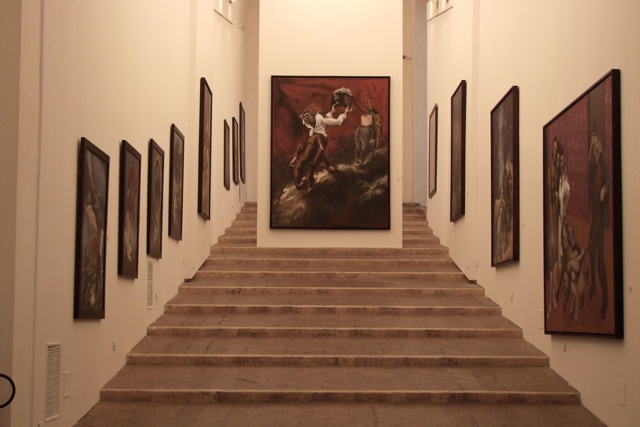
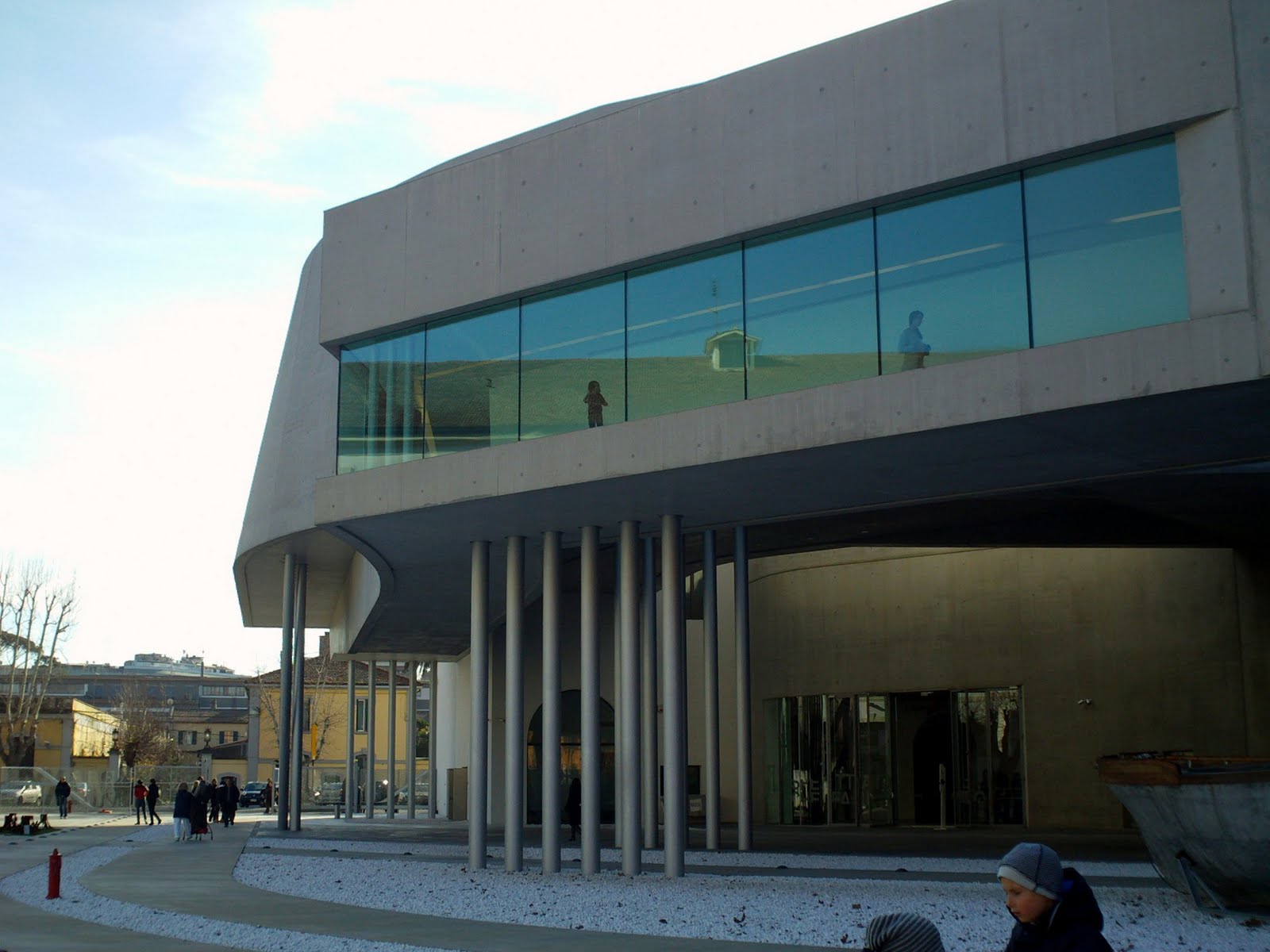
The Museum of Contemporary Art of Rome (MACRO) is a municipal art museum located in the north-east of Rome, on Via Reggio Emilia.The project began in the late 1990s over the site old factories Peroni. After an initial phase of restructuring of the site which allowed the opening of six rooms in September 1999, the museum was officially opened October 11, 2002.Since July 2004, an extension is being built in order to present all of the permanent collection. These arrangements have been entrusted to the French architect Odile Decq. The MACRO's permanent collection includes a selection of some of the most significant expressions of the Italian art scene since the 1960s, such as the group Forma 1 with the works by Carla Accardi, Antonio Sanfilippo, Achille Perilli, Piero Dorazio, Leoncillo and Ettore Colla; the Arte Povera with Mario Ceroli and Pino Pascali.
The gallery collect works by such artists as Giovanni Albanese, Andrea Aquilanti, Gianni Asdrubali, Domenico Bianchi, Bruno Ceccobelli, Sarah Ciracì, Enzo Cucchi, Fabrice de Nola, Gianni Dessì. 


Best museums of Rome

Rome is an ancient city, therefore is full of interesting museums to visit but I would like to suggest you the main ones of rome:


Borghese Museum Art Galery
Via Prenestina, 685

The Vatican Museums
(the Sistine Chapel, the Etruscan and Egyptian Museums, Raphael’s Rooms, the Gallery of Tapestries)
Viale Vaticano, Città del Vaticano
Galleria Doria Pamphili Via del Corso, 305

Galleria Nazionale d'Arte Moderna
Via delle Belle Arti 131

Palazzo Massimo
Piazza dei Cinquecento, 68

venerdì 21 gennaio 2011

National Gallery of Modern Art

The National Gallery of Modern Art  is an art gallery in Rome dedicated to modern art.
It is located at Via delle Belle Arti, near the Etruscan Museum. With its neoclassical and Romantic paintings and sculptures, it marks a dramatic change from the glories of the Renaissance and ancient Rome. Its 75 rooms house the largest collection of works by 19th- and 20th-century Italian artists including Giacomo Balla, Umberto Boccioni, Giorgio de Chirico, Giovanni Fattori, Amedeo Modigliani, Giorgio Morandi, Giacomo Manzù, Alberto Burri, Antonio Canova.
There are also a few notable works by foreign artists, including Calder, Cézanne, Duchamp, Giacometti, Braque, Degas, Wassily Kandinsky, Mondrian, Monet, Jackson Pollock, Rodin, Van Gogh and Klein.

This is the Official Gallery Site:
http://www.gnam.beniculturali.it/index.php?en/1/home


giovedì 20 gennaio 2011

Villa Doria Pamphili

The Villa Doria Pamphili is a seventeenth century villa with what is today the largest landscaped public park in Rome. It is located in the quarter of Monteverde, on the Gianicolo, just outside the Porta San Pancrazio in the ancient walls of Rome where the ancient road of the Via Aurelia commences.
It began as a villa for the Pamphili family and when the line died out in the eighteenth century, it passed to Prince Giovanni Andrea IV Doria from which time it has been known as the Villa Doria Pamphili.
The exterior containing statues gives a rich allure that was architecturally somewhat conservative for its date, looking back towards the Villa Medici or the Casina Pio IV, and rather more Mannerist than Baroque. It offered a forestaste of the richly stuccoed and frescoed interiors, where the iconographic program set out to establish the antiquity of the Pamphili, a family then somewhat parvenu in Rome, with origins in Gubbio. Inside, Algardi provided further bas-reliefs and stucco framing for the heroic frescoes drawn from Roman history painted by Grimaldi.

Borghese Art Gallery

The Borghese Gallery  is an art gallery in Rome housed in the former Villa Borghese Pinciana, a building that was from the first integral with its gardens, nowadays considered quite separately by tourists as the Villa Borghese gardens. The Galleria Borghese houses a substantial part of the Borghese collection of paintings, sculpture and antiquities, begun by Cardinal Scipione Borghese, the nephew of Pope Paul V (reign 1605–1621). The Villa was built by the architect Flaminio Ponzio, developing sketches by Scipione Borghese himself, who used it as a villa suburbana, a party villa at the edge of Rome.
Scipione Borghese was an early patron of Bernini and an avid collector of works by Caravaggio, who is well represented in the collection by his Boy with a Basket of Fruit, St. Jerome, Sick Bacchus and others.


This is the GALLERIA BORGHESE website:
http://www.galleriaborghese.it/

Villa Medici


The Villa Medici is an architectural complex centred on the villa whose gardens are contiguous with the larger Borghese gardens, on the Pincian Hill next to Trinità dei Monti in Rome. The Villa Medici, founded by Ferdinando I de' Medici, Grand Duke of Tuscany and now property of the French State, has housed the French Academy in Rome since 1803. A musical evocation of its garden fountains features in Ottorino Respighi's Fontane di Roma.
In 1803, Napoleon Bonaparte moved the French Academy in Rome to the Villa Medici with the intention of preserving an institution once threatened by the French Revolution. 
From that time on, the boarders no longer belonged solely to the traditional disciplines (painting, sculpture, architecture, metal-engraving, precious-stone engraving, musical composition, etc.) but also to new or previously-neglected artistic fields (art history, archaeology, literature, stagecraft, photography, movies, video, art restoration, writing and even cookery.) Artists are no longer recruited by a competition but by application, and their stays generally vary from six to eighteen months.


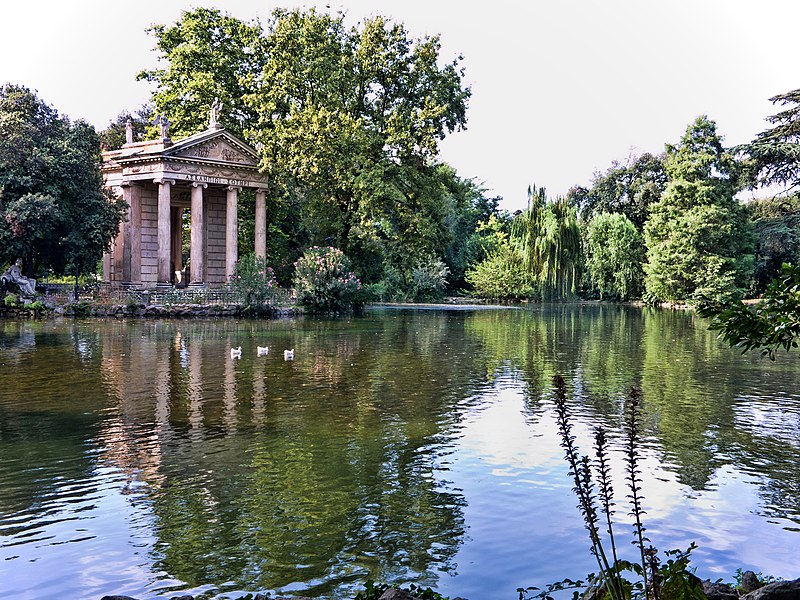
Beautiful Borghese Gardens

Villa Borghese is a large landscape garden in the naturalistic English manner in Rome, containing a number of buildings, museums and attractions. It is the second largest public park in Rome (80 hectares ) after that of the Villa Doria Pamphili. The gardens were developed for the Villa Borghese Pinciana ("Borghese villa on the Pincian Hill"), built by the architect  Ponzio, developing sketches by Scipione Borghese, who used it as a villa suburbana, a party villa, at the edge of Rome, and to house his art collection. The gardens as they are now were remade in the early nineteenth century.
  • Today the Galleria Borghese is housed in the Villa Borghese itself. The garden Casino Borghese, built on a rise above the Villa by the architect Giovanni Vasanzio, was set up by Camillo Borghese to contain sculptures by Bernini from the Borghese collection, including his David and his Daphne, and by Antonio Canova, with paintings by Titian, Raphael and Caravaggio.
  • The Villa Giulia adjoining the Villa Borghese gardens was built in 1551 - 1555 as a summer residence for Pope Julius III; now it contains the Etruscan Museum.
  • The Villa Medici houses the French Academy in Rome. In the 1650s, Diego Velázquez painted several depictions of this Villa's garden casino festively illuminated at night. Before electricity, such torchlit illuminations carried an excitement hard to conceive today.
  • Other villas scattered through the Villa Borghese gardens are remains of a world exposition in Rome in 1911.
    • The Galleria Nazionale d'Arte Moderna located in its grounds has a collection of 19th and 20th century paintings emphasizing Italian artists.
    • Architecturally the most notable of the 1911 exposition pavilions is the English pavilion designed by Sir Edwin Lutyens now housing the British School at Rome.

domenica 16 gennaio 2011

Throw a coin in ....and you'll come back to Rome

A traditional legend holds that if visitors throw a coin into the fountain, they are ensured a return to the Eternal City. Among those who are unaware that the "three coins" of Three Coins in the Fountain were thrown by three different individuals, a reported current interpretation is that two coins will lead to a new romance and three will ensure either a marriage or divorce. Another reported version of this legend is that it is lucky to throw three coins with one's right hand over one's left shoulder into the Trevi Fountain.
An estimated 3,000 euros are thrown into the fountain each day. The money has been used to subsidize a supermarket for Rome's needy. However, there are regular attempts to steal coins from the fountain.


Along the Spanish Steps

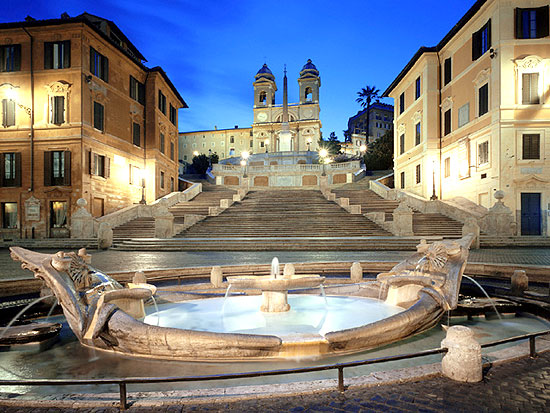
The Spanish Steps (Scalinata della Trinità dei Monti) are a set of steps climbing a steep slope between the Piazza di Spagna at the base and Piazza Trinità dei Monti, dominated by the church of Trinità dei Monti. The Scalinata is the widest staircase in Europe.
In the Piazza at the base is the Early Baroque fountain called Fontana della Barcaccia ("Fountain of the Old Boat"), built in 1627-29 and often credited to Pietro Bernini.
During May, part of the steps are covered by pots of azaleas. In modern times the Spanish Steps have included a small cut-flower market. The steps are not a place for eating lunch, being forbidden by Roman urban regulations, but they are usually crowded with people.
In the piazza, at the corner on the right as one begins to climb the steps, is the house where English poet John Keats lived and died in 1821; it is now a museum dedicated to his memory, full of memorabilia of the English Romantic generation.
At the top the Viale ramps up the Pincio which is the Pincian Hill, omitted, like the Janiculum, from the classic Seven hills of Rome. From the top of the steps the Villa Medici can be reached.


martedì 11 gennaio 2011

The Capitoline Museums

The Capitoline Museums are composed of three main buildings surrounding the Piazza del Campidoglio and interlinked by an underground gallery beneath the piazza.
The three main buildings of the Capitoline Museums are:
  • Palazzo Senatorio, built in the 12th century and modified according to Michelangelo's designs;
  • Palazzo dei Conservatori, built in the mid-16th century and redesigned by Michelangelo with the first use of the giant order column design; and
  • Palazzo Nuovo, built in the 17th century with an identical exterior design to the Palazzo dei Conservatori, which it faces across the palazzo.
In addition, the 16th century Palazzo Caffarelli-Clementino, located off the piazza adjacent to the Palazzo dei Conservatori, was added to the museum complex in the early 20th century.
The third floor of the Palazzo dei Conservatori houses the Capitoline Art Gallery, housing the museums' painting and applied art galleries. The Capitoline Coin Cabinet, containing collections of coins, medals, jewels, and jewelry, is located in the attached Palazzo Caffarelli-Clementino.


martedì 21 dicembre 2010

Mouth of Truth

La Bocca della Verità ("the Mouth of Truth") is an image, carved from Pavonazzetto marble, of a man-like face, located in the portico of the church of Santa Maria in Cosmedin in Rome. The sculpture is thought to be part of a 1st century ancient Roman fountain, or perhaps a manhole cover, portraying one of several possible pagan gods, probably Oceanus. Most Romans believe that the 'Bocca' represents the ancient god of the river Tiber.
The Mouth of Truth is known to English-speaking audiences mostly from its appearance in the 1953 film Roman Holiday. The film also uses the Mouth of Truth as a storytelling device since both Hepburn's and Peck's characters are not initially truthful with each other.
The most famous characteristic of the Mouth, however, is its role as a lie detector. Starting from the Middle Ages, it was believed that if one told a lie with one's hand in the mouth of the sculpture, it would be bitten off. The piece was placed in the portico of the Santa Maria in Cosmedin in the 17th century.This church is also home to the supposed relics of the saint, St Valentine.

VILLA ADA

This beatutiful  garden is  often chosen to organise jazz concerts in summer.
Villa Ada
The beautiful grounds are located just north of Rome and are both an ideal place to relax on a bench and enjoy the sunshine, or participate in the many activities that are available, such as the roller-skating rink, bike paths, playgrounds or to simply sit by the ponds.
Villa Ada is the largest park in Rome with a surface of 450 acres/182 hectares. It is located in the northeastern part of the city. Its highest prominence is Monte Antenne, 7 m (220 ft), an ancient archeological site.
The public portion of the park is much larger than the private area. It contains an artificial lake and many trees, including stone pines, holm oaks, laurels and a very rare metasequoia, imported from Tibet in 1940. Entrance to the park is free. One may rent canoes, bicycles, or riding horses. There is a large swimming pool.
Since 1994, during the summer the park hosts the world-music festival and the "Roma incontra il mondo" (Rome meets the World) festival, against racism, war and death penalty.

lunedì 20 dicembre 2010

The Mouth of Truth

The Mouth of Truth is well known to English-speaking audiences mostly from its appearance in the film Roman Holiday. The film also uses the Mouth of Truth as a storytelling device since both Hepburn's and Peck's characters are not initially truthful with each other.
La Bocca della Verità ("the Mouth of Truth") is an image, carved from Pavonazzetto marble, of a man-like face, located in the portico of the church of Santa Maria in Cosmedin in Rome. The sculpture is thought to be part of a 1st century ancient Roman fountain, or perhaps a manhole cover, portraying one of several possible pagan gods, probably Oceanus. Most Romans believe that the 'Bocca' represents the ancient god of the river Tiber.
The most famous characteristic of the Mouth, however, is its role as a lie detector. Starting from the Middle Ages, it was believed that if one told a lie with one's hand in the mouth of the sculpture, it would be bitten off. The piece was placed in the portico of the Santa Maria in Cosmedin in the 17th century.


giovedì 16 dicembre 2010

The Lake of Bracciano...just outside Rome..!

Bracciano  is a small town in the region of Lazio, 30 km northwest of Rome. The town is famous for its volcanic lake (Lago di Bracciano, the eighth largest lake in Italy) and for a particularly well-preserved medieval castle. The lake is widely used for sailing and is popular with tourists; the castle has hosted a number of events, especially weddings of actors and singers.
The town is served by an urban railway which connects it with Rome  in about 55 minutes. Close to it lie the two medieval towns of Anguillara Sabazia and Trevignano Romano.
The main monument of Bracciano is its castle, Castello Orsini-Odescalchi, one of the most noteworthy examples of Renaissance military architecture in Italy.

3 km outside the city, alongside the road leading to Trevignano Romano, is the ancient church of San Liberato.
The lake is an important tourist attraction situated near Rome. As it serves as a drinking water reservoir for the city of Rome it has been under control since 1986 in order to avoid pollution of its waters. The use of motorboats is strictly forbidden, and a centralised sewer system has been built for all the bordering towns in order to avoid any spoiling of the water quality. This makes Bracciano one of the cleanest lakes of Italy. The absence of motorized navigation favours sailing, canoeing and swimming.
In the last few years the lake and its surroundings have been brought under further protection by the creation of a regional park, the Parco Regionale del complesso lacuale di Bracciano Martignano.


PERSONAL INFORMATION

Please leave a message or a comment .....your own impressions and suggestions about this web site....I will be delighted to read you. I work as translator and congress operator as well as Language Assistant for foreigners coming visit the Eternal City .
Feel free to add any comment or ask me information about my job.

MARIA ANGELA

PERSONAL INFORMATION

Translation Services from/into English, French, Italian,Welcoming Service,Congress Operator, Language Assistance into English, French, Italian.

MARIA ANGELA